
rail-pictures.com Linie rail-pictures.com
No registration required - login with Google, Facebook or X account! Hello guest, you are not logged in. Log in | Create account 
Forum   Contact   Legal notice
English German French Italian Spanish Polish Dutch japanisch Swedish 

Photos by Stefan Wohlfahrt
18759 Photos
In Chaulin, the RhB Bernina Railway Ge 4/4 81—part of the Blonay–Chamby Railway collection—awaits its next assignment.
Oct 3, 2026
In Chaulin, the RhB Bernina Railway Ge 4/4 81—part of the Blonay–Chamby Railway collection—awaits its next assignment. Oct 3, 2026
Stefan Wohlfahrt

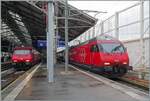
Two Re 460 locomotives with InterRegio (IR) trains! Such a sight has become increasingly rare, as passenger services are now predominantly operated by multiple-unit trainsets. This particular scene came about because the train composition for the IR 90 service from Brig to Genève had to be swapped in Lausanne; consequently, the train on the left is terminating here, while the one on the right is beginning its journey. Nov 9, 2026
Stefan Wohlfahrt

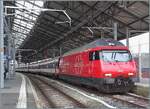
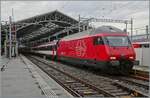
Once again, an SBB Re 460 locomotive—hauling an InterRegio (IR) train from Brig to Geneva that terminates in Lausanne (with a cross-platform connection available)—is seen beneath the train shed at Lausanne station. 

November 9, 2026
Once again, an SBB Re 460 locomotive—hauling an InterRegio (IR) train from Brig to Geneva that terminates in Lausanne (with a cross-platform connection available)—is seen beneath the train shed at Lausanne station. November 9, 2026
Stefan Wohlfahrt

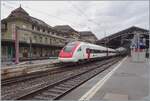
No sooner had the two Re 460 locomotives departed—or rather, moved to the stabling sidings—than the IR 15 service from Lucerne to Geneva Airport arrived at Lausanne station. Typically, SBB RABe 502 trainsets are used on this route; however, there are occasional exceptions, one of which can be seen here. Nov. 9, 2026
Stefan Wohlfahrt

SBB RABDe 500 024  Ernest von Stockalper  waits in Lausanne, operating as an IC5 service bound for Rorschach. The train has already undergone an extensive overhaul and now features an updated livery.

Nov 9, 2026
SBB RABDe 500 024 "Ernest von Stockalper" waits in Lausanne, operating as an IC5 service bound for Rorschach. The train has already undergone an extensive overhaul and now features an updated livery. Nov 9, 2026
Stefan Wohlfahrt

A world first! Stadler’s ARST SRHe 103.001 is currently in Ramsen. Stadler is testing this hydrogen-powered narrow-gauge train on the Hemishofen–Ramsen line; to make this possible, a third rail has been added to the standard-gauge track, allowing the narrow-gauge trains—which use the 950 mm Italian-style gauge—to operate there.

Nov 24, 2026
A world first! Stadler’s ARST SRHe 103.001 is currently in Ramsen. Stadler is testing this hydrogen-powered narrow-gauge train on the Hemishofen–Ramsen line; to make this possible, a third rail has been added to the standard-gauge track, allowing the narrow-gauge trains—which use the 950 mm Italian-style gauge—to operate there. Nov 24, 2026
Stefan Wohlfahrt

The SRHe 213.001, manufactured by Stadler for the FdC, is undergoing testing on the line near Ramsen.
The UIC numbers for the new hydrogen-powered narrow-gauge train are as follows: 90 83 4213 001-4 I-FdC; for the motor car in the middle, 90 83 4213 201-8 I-FdC; and for the third car, 90 83 4213 101-2 I-FdC.

The hydrogen-powered narrow-gauge trainset has the following axle arrangement: Bo 2 - 2 2 - 2 - Bo. This means the trainset is propelled via its front and rearmost bogies; the power car—unlike the GTW, for example—has no driven axles.

Nov. 24, 2026
The SRHe 213.001, manufactured by Stadler for the FdC, is undergoing testing on the line near Ramsen. The UIC numbers for the new hydrogen-powered narrow-gauge train are as follows: 90 83 4213 001-4 I-FdC; for the motor car in the middle, 90 83 4213 201-8 I-FdC; and for the third car, 90 83 4213 101-2 I-FdC. The hydrogen-powered narrow-gauge trainset has the following axle arrangement: Bo 2 - 2 2 - 2 - Bo. This means the trainset is propelled via its front and rearmost bogies; the power car—unlike the GTW, for example—has no driven axles. Nov. 24, 2026
Stefan Wohlfahrt

Captured with a long zoom: the new Stadler hydrogen-powered narrow-gauge train, SRHe 213 001—destined for the FdC—sits before the entry signal at Ramsen. Stadler is currently testing various parameters here to ensure that, following successful trials, the train can be quickly put into service by the client. Also clearly visible is the third rail installed by Stadler, which allows trains built for the 950 mm  Italian-gauge  (meter-gauge variant) to conduct their test runs on this line.

Nov 24, 2026
Captured with a long zoom: the new Stadler hydrogen-powered narrow-gauge train, SRHe 213 001—destined for the FdC—sits before the entry signal at Ramsen. Stadler is currently testing various parameters here to ensure that, following successful trials, the train can be quickly put into service by the client. Also clearly visible is the third rail installed by Stadler, which allows trains built for the 950 mm "Italian-gauge" (meter-gauge variant) to conduct their test runs on this line. Nov 24, 2026
Stefan Wohlfahrt

The new Stadler hydrogen-powered narrow-gauge train, SRHe 213 001—destined for the FdC—will shortly arrive at Ramsen station following its test run on the open line.

Nov 24, 2026
The new Stadler hydrogen-powered narrow-gauge train, SRHe 213 001—destined for the FdC—will shortly arrive at Ramsen station following its test run on the open line. Nov 24, 2026
Stefan Wohlfahrt

I had hoped that, upon reaching the destination of my long journey to Ramsen, I might encounter one of the new hydrogen-powered narrow-gauge trainsets—destined for Southern Italy—and that it wouldn’t be  hidden away  or shielded from view. Well, to my delight and surprise, there wasn’t just one, but three of these new hydrogen-powered narrow-gauge trainsets from Stadler to see and photograph! This image shows the SRHe 113 001, which operates here on a 950 mm gauge track—a line installed by Stadler specifically to test this world-first technology between Hemishofen and Ramsen.

November 24, 2026
I had hoped that, upon reaching the destination of my long journey to Ramsen, I might encounter one of the new hydrogen-powered narrow-gauge trainsets—destined for Southern Italy—and that it wouldn’t be "hidden away" or shielded from view. Well, to my delight and surprise, there wasn’t just one, but three of these new hydrogen-powered narrow-gauge trainsets from Stadler to see and photograph! This image shows the SRHe 113 001, which operates here on a 950 mm gauge track—a line installed by Stadler specifically to test this world-first technology between Hemishofen and Ramsen. November 24, 2026
Stefan Wohlfahrt

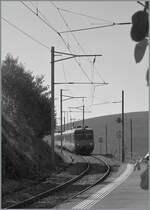
Coming from Le Brassus, the PBr regional train bound for Vallorbe arrives at the Les Charbonnières stop. 
The train consists of the CJ RBDe 560 141, a driving trailer (Bt), and an SBB EW II AB carriage—a combination that does not match well in terms of color, which is why I opted for a black-and-white image here.

Oct. 4, 2009
Coming from Le Brassus, the PBr regional train bound for Vallorbe arrives at the Les Charbonnières stop. The train consists of the CJ RBDe 560 141, a driving trailer (Bt), and an SBB EW II AB carriage—a combination that does not match well in terms of color, which is why I opted for a black-and-white image here. Oct. 4, 2009
Stefan Wohlfahrt

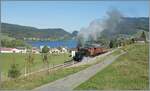
In the Vallée de Joux, a  Tigerli  locomotive—specifically the E 3/3 No. 8523, operated by the CTVJ (Compagnie du Train à Vapeur de la Vallée du Joux)—is also in service as part of a heritage railway operation. The company maintains tracks and depot facilities in Le Pont.

The image shows the dainty locomotive on an incline shortly after Les Charbonnières, traveling toward Le Brassus, with Lac Brenet visible in the background.

Oct. 4, 2009
In the Vallée de Joux, a "Tigerli" locomotive—specifically the E 3/3 No. 8523, operated by the CTVJ (Compagnie du Train à Vapeur de la Vallée du Joux)—is also in service as part of a heritage railway operation. The company maintains tracks and depot facilities in Le Pont. The image shows the dainty locomotive on an incline shortly after Les Charbonnières, traveling toward Le Brassus, with Lac Brenet visible in the background. Oct. 4, 2009
Stefan Wohlfahrt

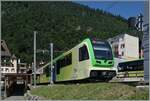
The TPC ASD ABe 4/8 471 arrives in Aigle; it will continue its journey after a change in direction and once the opposing train has passed.

July 27, 2024
The TPC ASD ABe 4/8 471 arrives in Aigle; it will continue its journey after a change in direction and once the opposing train has passed. July 27, 2024
Stefan Wohlfahrt

On the southern ramp of the Gotthard Railway, an SOB RABe 526  TRAVERSO —operating as a *treno Gotthardo*—is en route to Locarno. Having passed the Dazio Grande a few kilometers before Faido, it will soon traverse another spiral tunnel before crossing the well-known Pollegio Bridge.

Sept. 4, 2023
On the southern ramp of the Gotthard Railway, an SOB RABe 526 "TRAVERSO"—operating as a *treno Gotthardo*—is en route to Locarno. Having passed the Dazio Grande a few kilometers before Faido, it will soon traverse another spiral tunnel before crossing the well-known Pollegio Bridge. Sept. 4, 2023
Stefan Wohlfahrt

During a special excursion organized by  Rail One  (l'emission ferroviarie suisse), the SBB Historic  Red Arrow  (Roter Pfeil) RAe 2/4 1001—bearing the UIC number 094 85 75-91 001-3—could be admired in Lausanne. A sharp decline in passenger numbers following the economic crisis of the 1930s prompted the development of lightweight railcars, designed to operate services more cost-effectively. Consequently, the SBB (Swiss Federal Railways) acquired nine lightweight steel railcars, which entered service starting in 1935; two of these were diesel-powered rather than electric. In addition, three two-car articulated units were also procured. Almost immediately after delivery, the railcars proved too small—the popular  Red Arrows,  as they came to be known, fell victim to their own success. Even after they were retrofitted with couplers and buffers to allow for the attachment of an additional carriage, the  Red Arrows  could no longer be used for their originally intended purpose. From then on, these beloved units were relegated to special group excursions—a role they continue to serve to this day. Only two RAe 2/4 units remain in operational condition: the OeBB RAe 2/4 1007 (also designated 202) and the SBB Historic RAe 2/4 1001, which is featured in this photograph. January 17, 2026
During a special excursion organized by "Rail One" (l'emission ferroviarie suisse), the SBB Historic "Red Arrow" (Roter Pfeil) RAe 2/4 1001—bearing the UIC number 094 85 75-91 001-3—could be admired in Lausanne. A sharp decline in passenger numbers following the economic crisis of the 1930s prompted the development of lightweight railcars, designed to operate services more cost-effectively. Consequently, the SBB (Swiss Federal Railways) acquired nine lightweight steel railcars, which entered service starting in 1935; two of these were diesel-powered rather than electric. In addition, three two-car articulated units were also procured. Almost immediately after delivery, the railcars proved too small—the popular "Red Arrows," as they came to be known, fell victim to their own success. Even after they were retrofitted with couplers and buffers to allow for the attachment of an additional carriage, the "Red Arrows" could no longer be used for their originally intended purpose. From then on, these beloved units were relegated to special group excursions—a role they continue to serve to this day. Only two RAe 2/4 units remain in operational condition: the OeBB RAe 2/4 1007 (also designated 202) and the SBB Historic RAe 2/4 1001, which is featured in this photograph. January 17, 2026
Stefan Wohlfahrt

DB ICE 411 055, operating as ICE 1217, has arrived at its destination, Bregenz, coming from Munich. This is not the first time I have traveled to Bregenz to photograph an ICE train—though back then, it was an ET 4010 arriving from Vienna Westbahnhof...

As for this particular shot: once all the passengers have disembarked, the ICE heads to the stabling yard in Wolfurt.

August 14, 2021
DB ICE 411 055, operating as ICE 1217, has arrived at its destination, Bregenz, coming from Munich. This is not the first time I have traveled to Bregenz to photograph an ICE train—though back then, it was an ET 4010 arriving from Vienna Westbahnhof... As for this particular shot: once all the passengers have disembarked, the ICE heads to the stabling yard in Wolfurt. August 14, 2021
Stefan Wohlfahrt

Germany / High speed trains (ICE) / 411 (ICE-T)

24 1200x820 Px, 22.11.2026

In Lausanne steht der mit Olympischer Werbung geschmückte Liria TGV Rame 4718.

2. Sept. 2024
In Lausanne steht der mit Olympischer Werbung geschmückte Liria TGV Rame 4718. 2. Sept. 2024
Stefan Wohlfahrt

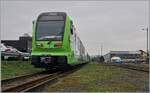
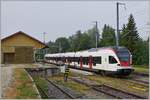
Replacing the TRAVYS  Domino  trains that previously ran from Le Brassus to Vallorbe, SBB RABe 523  Flirt  units now operate between Le Brassus and Aigle (via Le Day); pictured here is SBB RABe 523 022, serving as an S2 train, departing from Le Pont.

August 15, 2022
Replacing the TRAVYS "Domino" trains that previously ran from Le Brassus to Vallorbe, SBB RABe 523 "Flirt" units now operate between Le Brassus and Aigle (via Le Day); pictured here is SBB RABe 523 022, serving as an S2 train, departing from Le Pont. August 15, 2022
Stefan Wohlfahrt

Switzerland / Electric multiple units / 523

34 1600x1071 Px, 22.11.2026

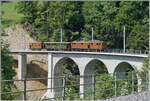
The Bernina Railway RhB Ge 4/4 81, belonging to the Blonay–Chamby Railway, is seen here hauling an interesting train across the newly renovated Baye de Clarnes viaduct, en route to Chaulin.

June 8, 2025
The Bernina Railway RhB Ge 4/4 81, belonging to the Blonay–Chamby Railway, is seen here hauling an interesting train across the newly renovated Baye de Clarnes viaduct, en route to Chaulin. June 8, 2025
Stefan Wohlfahrt

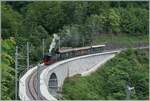
The SEG G 2x 2/2 105, belonging to the Blonay–Chamby Railway, is seen here hauling an interesting train across the newly renovated Baye de Clarnes viaduct, en route to Blonay.

June 8, 2025
The SEG G 2x 2/2 105, belonging to the Blonay–Chamby Railway, is seen here hauling an interesting train across the newly renovated Baye de Clarnes viaduct, en route to Blonay. June 8, 2025
Stefan Wohlfahrt

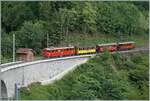
The RhB ABe 4/4 35 (formerly of the Bernina Railway), now part of the Blonay–Chamby Railway, is seen here as a passenger train near Vers Chez Robert—just before the newly renovated Baye de Clarnes viaduct—on its way to Blonay.

June 8, 2025
The RhB ABe 4/4 35 (formerly of the Bernina Railway), now part of the Blonay–Chamby Railway, is seen here as a passenger train near Vers Chez Robert—just before the newly renovated Baye de Clarnes viaduct—on its way to Blonay. June 8, 2025
Stefan Wohlfahrt

The  Train de Vignes  line in the vineyards above St-Saphorin—seen here from below, with an SBB RABe 523 train.

Nov. 16, 2024
The "Train de Vignes" line in the vineyards above St-Saphorin—seen here from below, with an SBB RABe 523 train. Nov. 16, 2024
Stefan Wohlfahrt

Here, the RABe 523 028 appears in practically the same spot as in the previous image; only the photographer’s position has changed significantly.

Nov. 11, 2024
Here, the RABe 523 028 appears in practically the same spot as in the previous image; only the photographer’s position has changed significantly. Nov. 11, 2024
Stefan Wohlfahrt

As the sun sets behind me, the Trenitalia ETR 610 002—operating as service EC 30008—travels between St-Saphorin and Rivaz, en route from Domodossola to Genève Aéroport.

November 15, 2024
As the sun sets behind me, the Trenitalia ETR 610 002—operating as service EC 30008—travels between St-Saphorin and Rivaz, en route from Domodossola to Genève Aéroport. November 15, 2024
Stefan Wohlfahrt