
rail-pictures.com
Keine Registrierung n�tig - Login mit Google-, Facebook- or X-Account! Hello guest, you are not logged in. Log in | Create account 
Forum   Contact   Legal notice
English German French Italian Spanish Polish Dutch japanisch Swedish 

Germany

8182 Photos
1 2 3 4 5 6 7 8 9 10 next page  >>
Uncommon on the Sieg route, the ICE 2, Tz 222  Eberswalde,  led by the power car 402 022-8, presumably running as an empty transfer train, passes through Scheuerfeld/Sieg towards Siegen on July 5, 2026.

The ICE 2, the second generation of high-speed trains in Germany, was put into service in 1996. Unlike the ICE 1, the ICE 2 is limited to six intermediate cars, one control car, and one power car.

A train consists of:
• Power car of class 402
• First-class car Apmz of class 805.3 as car 27 or 37
• First-class car Apmz of class 805.0 as car 26 or 36
• Onboard restaurant WRmbsz of class 807.0 as car 25 or 35
• Second-class service car Bpmbz of class 806.0 as car 24 / 34
• Second-class car Bpmz of class 806.3 as car 23 or 33
• Second-class car Bpmz of class 806.6 as car 22 or 32
• Second-class control car Bpmzf of class 808.0 as car 21 / 31
This train concept allows coupling two trains into a double train.

The ICE 2 follows the concept of double traction:
This enables flexible deployment – as double traction on routes with high demand and with half the seating capacity on routes with lower passenger volumes. The operational concept of the ICE 2 also considers  splitting  both train parts to different travel destinations, thus providing more direct connections without transfers. For example, two ICE 2 trains cover the route from Berlin to Hamm/Westphalia as a double train and then split there into two separate train services towards Essen/Düsseldorf and Hagen/Wuppertal, respectively.

Characteristic of the ICE 2 are the nose flaps on the power car and control car. They conceal the coupling to minimize air resistance during high-speed operation at up to 280 kilometers per hour. All ICE 2 trains underwent a comprehensive modernization starting in 2011, during which, among other things, the passenger information system was expanded to a total of six monitors per car and handrails were installed on the new seats.

TECHNICAL DATA:
Start of operation: 1996
Number of trains: 44
Track gauge: 1,435 mm (standard gauge)
Axle arrangement (power car): Bo’Bo’
Length over couplers (power car): 20,560 mm
Train length: 205.36 meters (power car, 6 intermediate cars, and control car)
Bogie wheelbase: 3,000 mm (power car) / 2,500 mm (cars)
Empty weight: 77.5 t (power car) and 412 t (7-car set incl. control car)
Maximum speed: 280 km/h
Continuous power output: 4,800 kW
Starting tractive effort: 200 kN
Wheel diameter: 920 mm (new) / 860 mm (worn)
Power system: 15 kV 16.7 Hz
Number of traction motors: 4
Drive: Cardan shaft
Brake system: KE R+E
Train protection system: Sifa, LZB 80/16 with PZB 90
Coupler type: Scharfenberg coupler
Seating capacity: 368 (pre-redesign) / 381 (post-redesign), comprising 106 First Class and 275 Second Class seats
Floor height: 1,226 mm above top of rail (TOR)
Uncommon on the Sieg route, the ICE 2, Tz 222 "Eberswalde," led by the power car 402 022-8, presumably running as an empty transfer train, passes through Scheuerfeld/Sieg towards Siegen on July 5, 2026. The ICE 2, the second generation of high-speed trains in Germany, was put into service in 1996. Unlike the ICE 1, the ICE 2 is limited to six intermediate cars, one control car, and one power car. A train consists of: • Power car of class 402 • First-class car Apmz of class 805.3 as car 27 or 37 • First-class car Apmz of class 805.0 as car 26 or 36 • Onboard restaurant WRmbsz of class 807.0 as car 25 or 35 • Second-class service car Bpmbz of class 806.0 as car 24 / 34 • Second-class car Bpmz of class 806.3 as car 23 or 33 • Second-class car Bpmz of class 806.6 as car 22 or 32 • Second-class control car Bpmzf of class 808.0 as car 21 / 31 This train concept allows coupling two trains into a double train. The ICE 2 follows the concept of double traction: This enables flexible deployment – as double traction on routes with high demand and with half the seating capacity on routes with lower passenger volumes. The operational concept of the ICE 2 also considers "splitting" both train parts to different travel destinations, thus providing more direct connections without transfers. For example, two ICE 2 trains cover the route from Berlin to Hamm/Westphalia as a double train and then split there into two separate train services towards Essen/Düsseldorf and Hagen/Wuppertal, respectively. Characteristic of the ICE 2 are the nose flaps on the power car and control car. They conceal the coupling to minimize air resistance during high-speed operation at up to 280 kilometers per hour. All ICE 2 trains underwent a comprehensive modernization starting in 2011, during which, among other things, the passenger information system was expanded to a total of six monitors per car and handrails were installed on the new seats. TECHNICAL DATA: Start of operation: 1996 Number of trains: 44 Track gauge: 1,435 mm (standard gauge) Axle arrangement (power car): Bo’Bo’ Length over couplers (power car): 20,560 mm Train length: 205.36 meters (power car, 6 intermediate cars, and control car) Bogie wheelbase: 3,000 mm (power car) / 2,500 mm (cars) Empty weight: 77.5 t (power car) and 412 t (7-car set incl. control car) Maximum speed: 280 km/h Continuous power output: 4,800 kW Starting tractive effort: 200 kN Wheel diameter: 920 mm (new) / 860 mm (worn) Power system: 15 kV 16.7 Hz Number of traction motors: 4 Drive: Cardan shaft Brake system: KE R+E Train protection system: Sifa, LZB 80/16 with PZB 90 Coupler type: Scharfenberg coupler Seating capacity: 368 (pre-redesign) / 381 (post-redesign), comprising 106 First Class and 275 Second Class seats Floor height: 1,226 mm above top of rail (TOR)
Armin Schwarz

The DB Cargo 193 375 with a long tank trai to the port of Antwerp. Build by Siemens: type: Vectron MS construction n° 22635 year of manufacture: 2019. Line 27A at Antwerp Airport. 02-07-2026
Mark Min

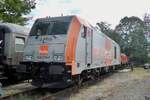
The 111 049-3 (91 80 6111 049-3 D-GfF) of GfF - Gesellschaft für Fahrzeugtechnik mbH (Crailsheim) is running on July 2, 2026, with an empty train consisting of two former InterRegio second-class coaches with multipurpose compartments (class Bimdz) through Kirchen/Sieg station towards Cologne. Once again, a warm greeting back to the friendly locomotive driver.

The locomotive was built in 1975 by Henschel in Kassel under factory number 31895 and delivered to Deutsche Bundesbahn. In the yellow/white livery (as shown here), the locomotive operated in 1990 and 1991 as the Lufthansa Airport Express on the LHA route Stuttgart–Frankfurt Airport. I think this color scheme suits the locomotive very well.
The 111 049-3 (91 80 6111 049-3 D-GfF) of GfF - Gesellschaft für Fahrzeugtechnik mbH (Crailsheim) is running on July 2, 2026, with an empty train consisting of two former InterRegio second-class coaches with multipurpose compartments (class Bimdz) through Kirchen/Sieg station towards Cologne. Once again, a warm greeting back to the friendly locomotive driver. The locomotive was built in 1975 by Henschel in Kassel under factory number 31895 and delivered to Deutsche Bundesbahn. In the yellow/white livery (as shown here), the locomotive operated in 1990 and 1991 as the Lufthansa Airport Express on the LHA route Stuttgart–Frankfurt Airport. I think this color scheme suits the locomotive very well.
Armin Schwarz

The 111 049-3 (91 80 6111 049-3 D-GfF) of GfF - Gesellschaft für Fahrzeugtechnik mbH (Crailsheim) is running on July 2, 2026, with an empty train consisting of two former InterRegio second-class coaches with multipurpose compartments (class Bimdz) through Kirchen/Sieg station towards Cologne. Once again, a warm greeting back to the friendly locomotive driver.

The locomotive was built in 1975 by Henschel in Kassel under factory number 31895 and delivered to Deutsche Bundesbahn. In the yellow/white livery (as shown here), the locomotive operated in 1990 and 1991 as the Lufthansa Airport Express on the LHA route Stuttgart–Frankfurt Airport. I think this color scheme suits the locomotive very well.
The 111 049-3 (91 80 6111 049-3 D-GfF) of GfF - Gesellschaft für Fahrzeugtechnik mbH (Crailsheim) is running on July 2, 2026, with an empty train consisting of two former InterRegio second-class coaches with multipurpose compartments (class Bimdz) through Kirchen/Sieg station towards Cologne. Once again, a warm greeting back to the friendly locomotive driver. The locomotive was built in 1975 by Henschel in Kassel under factory number 31895 and delivered to Deutsche Bundesbahn. In the yellow/white livery (as shown here), the locomotive operated in 1990 and 1991 as the Lufthansa Airport Express on the LHA route Stuttgart–Frankfurt Airport. I think this color scheme suits the locomotive very well.
Armin Schwarz

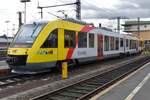
Two coupled LINT trains (one LINT 27 and one LINT 41, thus probably a LINT 68) of the HLB (Hessische Landesbahn) are running on June 11 2026, as RB 90  Westerwald-Sieg-Bahn  (Siegen - Betzdorf - Au - Altenkirchen - Westerburg), and are soon reaching Kirchen/Sieg station. At the front is the leading VT 208 (95 80 0640 108-6 D-HLB), an Alstom Coradia LINT 27, and at the rear the VT 253 (95 80 0648 153-4 D-HEB / 95 80 0648 653-3 D-HEB), an Alstom Coradia LINT 41.
Two coupled LINT trains (one LINT 27 and one LINT 41, thus probably a LINT 68) of the HLB (Hessische Landesbahn) are running on June 11 2026, as RB 90 "Westerwald-Sieg-Bahn" (Siegen - Betzdorf - Au - Altenkirchen - Westerburg), and are soon reaching Kirchen/Sieg station. At the front is the leading VT 208 (95 80 0640 108-6 D-HLB), an Alstom Coradia LINT 27, and at the rear the VT 253 (95 80 0648 153-4 D-HEB / 95 80 0648 653-3 D-HEB), an Alstom Coradia LINT 41.
Armin Schwarz

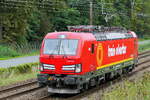
The TCA 7193 116 with the daily TCA shuttle from the port of Antwerp to the TCA container terminal at Athus near the French and Luxembourg border. Build by Siemens: type: Vectron MS construction n° 23968 year of manufacture: 2025. Line 27A at Antwerp Airport. 30-06-2026
Mark Min

The Siemens Vectron AC - 193 966  Ida  (91 80 6193 966-9 D-FOX) of the Hungarian FOXrail Zrt. (Budapest) is running on June 11, 2026, with a combined transport train (a LKW Walter full train), through Kirchen/Sieg towards Cologne.

The Siemens Vectron AC variant B14 was built in 2022 by Siemens Mobility in Munich-Allach under factory number 23005 and delivered to FOX rail. In the AC B14 variant, it has approvals for Germany, Austria, Hungary, Czech Republic, Slovakia, Romania, and Bulgaria (D / A / H / CZ / SK / RO / BG).
The Siemens Vectron AC - 193 966 "Ida" (91 80 6193 966-9 D-FOX) of the Hungarian FOXrail Zrt. (Budapest) is running on June 11, 2026, with a combined transport train (a LKW Walter full train), through Kirchen/Sieg towards Cologne. The Siemens Vectron AC variant B14 was built in 2022 by Siemens Mobility in Munich-Allach under factory number 23005 and delivered to FOX rail. In the AC B14 variant, it has approvals for Germany, Austria, Hungary, Czech Republic, Slovakia, Romania, and Bulgaria (D / A / H / CZ / SK / RO / BG).
Armin Schwarz

The TCA 7193 114 and 7193 116 with the daily TCA shuttle from the port of Antwerp to the TCA container terminal at Athus near the French and Luxembourg border. Build by Siemens: type: Vectron MS construction n° 23960 year of manufacture: 2025. Line 27A at Antwerp Airport. 16-06-2026
Mark Min

The SIEMENS Vectron Dual Mode 248 077 (90 80 2248 077-0 D-NRAIL) of BM-Bahndienste GmbH (Karlsruhe) is running on June 9, 2026, with a flatcar train (4 bogie flatcars of the Rens type), through Kirchen/Sieg station towards Siegen.

The SIEMENS Vectron DM was manufactured in 2023 by Siemens Mobility GmbH in Munich-Allach under factory number 23425 and delivered in January 2024 to BM-Bahndienste GmbH, which leased the locomotive via RRL - RIVE Rail Leasing Limited (Dublin), and the locomotive was commissioned by northrail GmbH.

The hybrid locomotive (Vectron Dual Mode) can draw its traction power from the overhead catenary (2,400 kW power at the wheel) or generate it using an MTU 16V 4000 R84 V16-cylinder diesel engine (2,400 kW engine power, 2,000 kW power at the wheel).
The SIEMENS Vectron Dual Mode 248 077 (90 80 2248 077-0 D-NRAIL) of BM-Bahndienste GmbH (Karlsruhe) is running on June 9, 2026, with a flatcar train (4 bogie flatcars of the Rens type), through Kirchen/Sieg station towards Siegen. The SIEMENS Vectron DM was manufactured in 2023 by Siemens Mobility GmbH in Munich-Allach under factory number 23425 and delivered in January 2024 to BM-Bahndienste GmbH, which leased the locomotive via RRL - RIVE Rail Leasing Limited (Dublin), and the locomotive was commissioned by northrail GmbH. The hybrid locomotive (Vectron Dual Mode) can draw its traction power from the overhead catenary (2,400 kW power at the wheel) or generate it using an MTU 16V 4000 R84 V16-cylinder diesel engine (2,400 kW engine power, 2,000 kW power at the wheel).
Armin Schwarz

The Train Charter Services E 186 289-5 with 3 passenger carriages to the train service depot in the port of Antwerp. Line 27A at Antwerp Airport. 26-06-2026
Mark Min

Germany / Electric locomotives / 186

66 1600x1066 Px, 28.06.2026

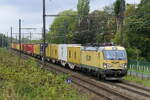
The DB Cargo 193 307 towing the 193 357(Das ist Grün) and a tank train from the port of Antwerp to Germany. Line 27A at Antwerp Airport. 22-06-2026
Mark Min

The Lineas 186 455-2 on the opposite track with a Hupac train from the port of Antwerp to Italy. In Belgium the standard is left hand driving, but almost all lines have the possibility to use tracks in both directions. In this case a passenger train will later overtake this one on the other track. Line 27A at Antwerp Airport. 22-06-2026
Mark Min

The Siemens Vectron MS - 193 110  Zugersee  (91 80 6193 110-4 D-Rpool) of Railpool GmbH (Munich), leased to SBB Cargo International AG, is passing through Kirchen/Sieg station towards Siegen on June 9, 2026, with a combined transport train operated by HUPAC.

The SIEMENS Vectron MS (X4E) was built in 2023 by Siemens Mobility in Munich-Allach under factory number 23293. The multisystem locomotive, designed with 6,400 kW, is executed in the A22 variant and thus has the approvals and corresponding country packages for Germany, Austria, Switzerland, Italy, and the Netherlands (D / A / CH / I / NL). It is the 300th locomotive of Railpool.
The Siemens Vectron MS - 193 110 "Zugersee" (91 80 6193 110-4 D-Rpool) of Railpool GmbH (Munich), leased to SBB Cargo International AG, is passing through Kirchen/Sieg station towards Siegen on June 9, 2026, with a combined transport train operated by HUPAC. The SIEMENS Vectron MS (X4E) was built in 2023 by Siemens Mobility in Munich-Allach under factory number 23293. The multisystem locomotive, designed with 6,400 kW, is executed in the A22 variant and thus has the approvals and corresponding country packages for Germany, Austria, Switzerland, Italy, and the Netherlands (D / A / CH / I / NL). It is the 300th locomotive of Railpool.
Armin Schwarz

The 193 345, DB Cargo, with a tank train from the port of Antwerp to Germany. Line 27A at Antwerp Airport. 26-06-2026
Mark Min

The Lineas 186 456-0 with the daily BASF shuttle from BASF Antwerpen to BASF Ludwigshafen. Line 27A at Antwerp Airport. 22-06-2026
Mark Min

The BLS Cargo 186 493 with a car train from Italy to the port of Zee-Brugge. Line 27a at Antwerp Airport. 22-06-2026
Mark Min

Hexafret E186 184-8 with a steel roll train on the way from the port of Antwerp to France. Line 27A at Antwerp Airport. 18-06-2026
Mark Min

The 185 028-8 (91 80 6185 028-8 D-DB) of DB Cargo AG, also approved for France, is running with a coil train through Kirchen/Sieg towards Siegen on June 9, 2026, presumably heading to Kreuztal. It is interesting that both pantographs for 15 kV, 16.7 Hz AC are raised on the contact wire.

The TRAXX F140 AC1 was built in 2001 by ADtranz (ABB Daimler-Benz Transportation GmbH) in Kassel under factory number 33427. It is approved for Germany and France. Thus, it is designed as a dual-system locomotive with the electrical systems 15 kV, 16.7 Hz AC and 25 kV, 50 Hz AC.
The 185 028-8 (91 80 6185 028-8 D-DB) of DB Cargo AG, also approved for France, is running with a coil train through Kirchen/Sieg towards Siegen on June 9, 2026, presumably heading to Kreuztal. It is interesting that both pantographs for 15 kV, 16.7 Hz AC are raised on the contact wire. The TRAXX F140 AC1 was built in 2001 by ADtranz (ABB Daimler-Benz Transportation GmbH) in Kassel under factory number 33427. It is approved for Germany and France. Thus, it is designed as a dual-system locomotive with the electrical systems 15 kV, 16.7 Hz AC and 25 kV, 50 Hz AC.
Armin Schwarz

Euro Cargo Rail E 186 168-1 on his way to the port of Antwerp. Line 27A at Antwerp Airport. 23-06-2026
Mark Min

SBBCI 193 544 hauls a container train through Kaarst Broicherseite on 8 May 2025. Due to a seriously delayed aceptance procedure for operating in Italy, the SBBCI X-Loar Vectrons (193 450-460) were first deployed into the Netherlands before being relocated to the projected Italy bound traffics from January 2026.
Leonardus Schrijvers

On 25 February 2025 SBBCI 193 543 hauls one of many intermodal trains through Hulten.
Leonardus Schrijvers

SBBCO 193 659 hauls an intermodal through Valburg CUP on 29 May 2026.
Leonardus Schrijvers

Side view on SBBCI 193 665 -as second in command- passing through Pratteln on 13 February 2024.
Leonardus Schrijvers

SBBCI 193 701 slowly crawls out of Emmerich into the Netherlands on 16 March 2024.
Leonardus Schrijvers

1 2 3 4 5 6 7 8 9 10 next page  >>


Statistik
 
Diese Webseite verwendet Cookies, um Inhalte und Anzeigen zu personalisieren und Zugriffe zu analysieren. Sie können zwischen personalisierter und nicht-personalisierter Werbung wählen.
Mit der Nutzung dieser Seite stimmen Sie der Verwendung von Cookies zu.