
rail-pictures.com
Keine Registrierung n�tig - Login mit Google-, Facebook- or X-Account! Ciao ospite, non hai effettuato l'accesso. Accedi | Crea account 
Forum   Contatto   Note legali
inglese tedesco francese italiano spagnolo polacco olandese japanisch svedese 

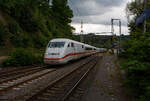
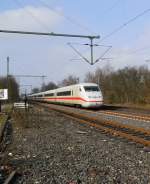
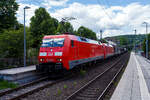
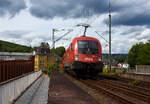
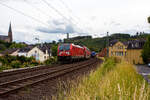
Uncommon on the Sieg route, the ICE 2, Tz 222 "Eberswalde," led by the power car 402 022-8, presumably running as an empty transfer train, passes through Scheuerfeld/Sieg towards Siegen on July 5,

(ID 58062)
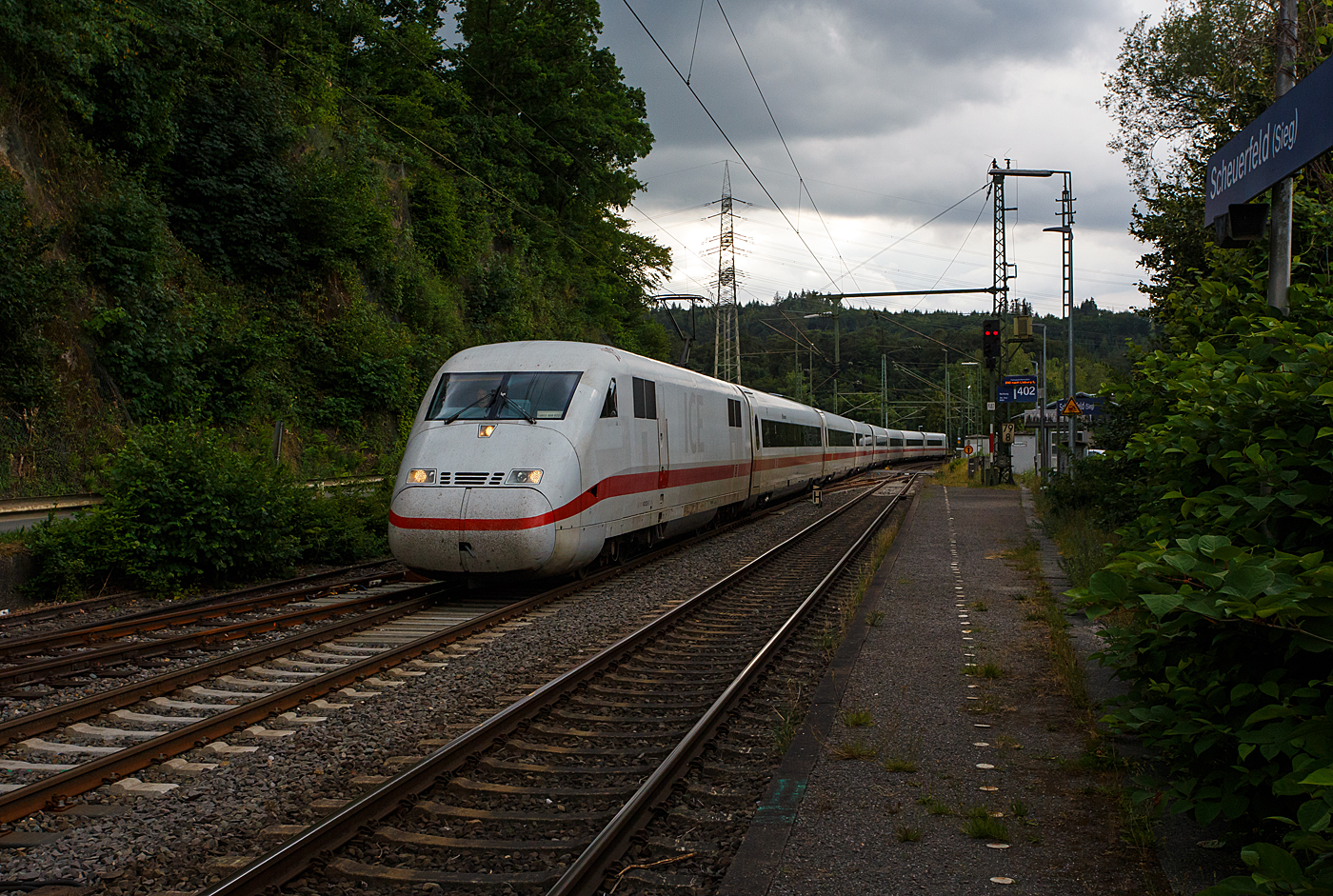


Uncommon on the Sieg route, the ICE 2, Tz 222  Eberswalde,  led by the power car 402 022-8, presumably running as an empty transfer train, passes through Scheuerfeld/Sieg towards Siegen on July 5, 2026.

The ICE 2, the second generation of high-speed trains in Germany, was put into service in 1996. Unlike the ICE 1, the ICE 2 is limited to six intermediate cars, one control car, and one power car.

A train consists of:
• Power car of class 402
• First-class car Apmz of class 805.3 as car 27 or 37
• First-class car Apmz of class 805.0 as car 26 or 36
• Onboard restaurant WRmbsz of class 807.0 as car 25 or 35
• Second-class service car Bpmbz of class 806.0 as car 24 / 34
• Second-class car Bpmz of class 806.3 as car 23 or 33
• Second-class car Bpmz of class 806.6 as car 22 or 32
• Second-class control car Bpmzf of class 808.0 as car 21 / 31
This train concept allows coupling two trains into a double train.

The ICE 2 follows the concept of double traction:
This enables flexible deployment – as double traction on routes with high demand and with half the seating capacity on routes with lower passenger volumes. The operational concept of the ICE 2 also considers  splitting  both train parts to different travel destinations, thus providing more direct connections without transfers. For example, two ICE 2 trains cover the route from Berlin to Hamm/Westphalia as a double train and then split there into two separate train services towards Essen/Düsseldorf and Hagen/Wuppertal, respectively.

Characteristic of the ICE 2 are the nose flaps on the power car and control car. They conceal the coupling to minimize air resistance during high-speed operation at up to 280 kilometers per hour. All ICE 2 trains underwent a comprehensive modernization starting in 2011, during which, among other things, the passenger information system was expanded to a total of six monitors per car and handrails were installed on the new seats.

TECHNICAL DATA:
Start of operation: 1996
Number of trains: 44
Track gauge: 1,435 mm (standard gauge)
Axle arrangement (power car): Bo’Bo’
Length over couplers (power car): 20,560 mm
Train length: 205.36 meters (power car, 6 intermediate cars, and control car)
Bogie wheelbase: 3,000 mm (power car) / 2,500 mm (cars)
Empty weight: 77.5 t (power car) and 412 t (7-car set incl. control car)
Maximum speed: 280 km/h
Continuous power output: 4,800 kW
Starting tractive effort: 200 kN
Wheel diameter: 920 mm (new) / 860 mm (worn)
Power system: 15 kV 16.7 Hz
Number of traction motors: 4
Drive: Cardan shaft
Brake system: KE R+E
Train protection system: Sifa, LZB 80/16 with PZB 90
Coupler type: Scharfenberg coupler
Seating capacity: 368 (pre-redesign) / 381 (post-redesign), comprising 106 First Class and 275 Second Class seats
Floor height: 1,226 mm above top of rail (TOR)

Uncommon on the Sieg route, the ICE 2, Tz 222 "Eberswalde," led by the power car 402 022-8, presumably running as an empty transfer train, passes through Scheuerfeld/Sieg towards Siegen on July 5, 2026.

The ICE 2, the second generation of high-speed trains in Germany, was put into service in 1996. Unlike the ICE 1, the ICE 2 is limited to six intermediate cars, one control car, and one power car.

A train consists of:
• Power car of class 402
• First-class car Apmz of class 805.3 as car 27 or 37
• First-class car Apmz of class 805.0 as car 26 or 36
• Onboard restaurant WRmbsz of class 807.0 as car 25 or 35
• Second-class service car Bpmbz of class 806.0 as car 24 / 34
• Second-class car Bpmz of class 806.3 as car 23 or 33
• Second-class car Bpmz of class 806.6 as car 22 or 32
• Second-class control car Bpmzf of class 808.0 as car 21 / 31
This train concept allows coupling two trains into a double train.

The ICE 2 follows the concept of double traction:
This enables flexible deployment – as double traction on routes with high demand and with half the seating capacity on routes with lower passenger volumes. The operational concept of the ICE 2 also considers "splitting" both train parts to different travel destinations, thus providing more direct connections without transfers. For example, two ICE 2 trains cover the route from Berlin to Hamm/Westphalia as a double train and then split there into two separate train services towards Essen/Düsseldorf and Hagen/Wuppertal, respectively.

Characteristic of the ICE 2 are the nose flaps on the power car and control car. They conceal the coupling to minimize air resistance during high-speed operation at up to 280 kilometers per hour. All ICE 2 trains underwent a comprehensive modernization starting in 2011, during which, among other things, the passenger information system was expanded to a total of six monitors per car and handrails were installed on the new seats.

TECHNICAL DATA:
Start of operation: 1996
Number of trains: 44
Track gauge: 1,435 mm (standard gauge)
Axle arrangement (power car): Bo’Bo’
Length over couplers (power car): 20,560 mm
Train length: 205.36 meters (power car, 6 intermediate cars, and control car)
Bogie wheelbase: 3,000 mm (power car) / 2,500 mm (cars)
Empty weight: 77.5 t (power car) and 412 t (7-car set incl. control car)
Maximum speed: 280 km/h
Continuous power output: 4,800 kW
Starting tractive effort: 200 kN
Wheel diameter: 920 mm (new) / 860 mm (worn)
Power system: 15 kV 16.7 Hz
Number of traction motors: 4
Drive: Cardan shaft
Brake system: KE R+E
Train protection system: Sifa, LZB 80/16 with PZB 90
Coupler type: Scharfenberg coupler
Seating capacity: 368 (pre-redesign) / 381 (post-redesign), comprising 106 First Class and 275 Second Class seats
Floor height: 1,226 mm above top of rail (TOR)

Armin Schwarz http://hellertal.startbilder.de/ 05.07.2026, 9 Visualizzazioni, 0 Commenti * automatisch übersetzt

EXIF: Canon Canon EOS 6D, Data 2026:07:05 18:24:12, Tempo di esposizione: 1/500, Diaframma: 11/1, ISO1600, Lunghezza focale: 40/1
0 Commenti, Tutti i commenti
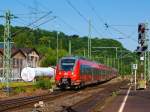
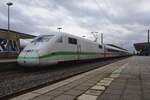
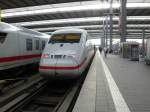
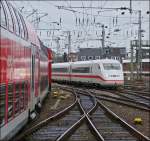
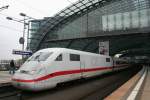
ICE 402 007 'STENDAL' lascia Bochum Hbf il 14 febbraio 2022 in direzione Hamm (Westfalen) dove un'unità gemella verrà aggiunta prima di proseguire attraverso Hannover Hbf verso Berlino - passando nel frattempo proprio accanto alla sua omonima Stendal.
Leonardus Schrijvers

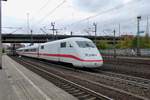
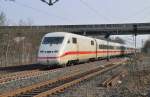
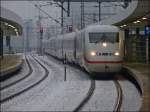
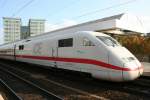
ICE 402 036 parte da Amburgo-Harburg il 27 aprile 2016.
Leonardus Schrijvers

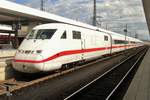
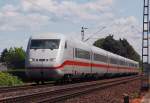
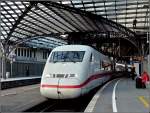
ICE 402 030 ferma a Norimberga Hbf il 15 settembre 2015.
Leonardus Schrijvers

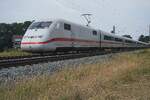
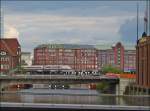
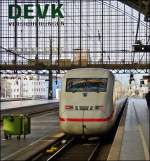
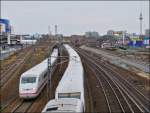
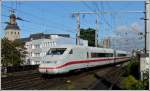
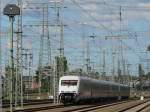
. ICE 2 fotografato sul ponte Oberhafenbrücke a Amburgo il 19 settembre 2013.
De Rond Hans und Jeanny

Germania / Treni ad alta velocità (ICE) / 402 (ICE 2)

1064 1200x893 Px, 23.09.2013


Statistik
 
Diese Webseite verwendet Cookies, um Inhalte und Anzeigen zu personalisieren und Zugriffe zu analysieren. Sie können zwischen personalisierter und nicht-personalisierter Werbung wählen.
Mit der Nutzung dieser Seite stimmen Sie der Verwendung von Cookies zu.