
rail-pictures.com
Keine Registrierung nötig - Login mit Google-, Facebook- or X-Account! Hallo Gast, Sie sind nicht eingeloggt. Einloggen | Account anmelden 
Forum   Kontakt   Impressum
englisch deutsch französisch italienisch spanisch polnisch niederländisch 

2 Bilder
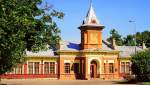
In the 17th century, the town of Ventspils (Windau, Windawa) was known as a shipbuilding center of the Duchy of Courland, a small semi-independent state in the Baltic region that established its colonies Gambia in West Africa and Tobago in Caribbean, and even laid plans to colonise Australia. Today, Ventspils (44, 000) is an industrial town and Latvia's busiest seaport. The partly wooden building of the train station is located 2 km east from the city center, across the Venta river. Description & Photo: Summer 1999.
Im 17. Jahrhundert war die Stadt Ventspils (Windau, Windawa) als Schiffbauzentrum des Herzogtums Kurland bekannt, eines kleinen halbautonomen Staates in der Ostseeregion, der Kolonien in Gambia in Westafrika und Tobago in der Karibik gründete und sogar Pläne zur Kolonisierung Australiens schmiedete. Heute ist Ventspils (44.000 Einwohner) eine Industriestadt und der verkehrsreichste Seehafen Lettlands. Das teilweise hölzerne Bahnhofsgebäude befindet sich 2 km östlich vom Stadtzentrum, auf der anderen Seite des Flusses Venta. Beschreibung & Foto: Sommer 1999.
Jarosław Swajdo

Lettland / Stationen / Verschiedenes

1192  2 1024x584 Px, 04.08.2014

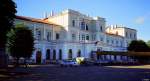
Liepāja, Latvia's third biggest town, situated in Lower Courland 220 km from Riga on the Baltic coast, is the industrial city with an ice-free harbour and a huge metallurgical complex (Liepājas Metalurgs). The second half of the 19th century saw the rapid expansion of industry and industrial related activities. Having direct railway connection with the fertile parts of southern and south-eastern Russia, Liepāja (Libau, Lipawa) has become the modern port for foreign trade on the Baltic specialized in exporting Russian grain. Before WWI Liepāja was also the biggest Russian emigration port. It had a regular transatlantic shipping service to New York and Halifax, between 1906 and 1913 ca. 330,000 emigrants from Eastern Europe passed through the city on their way to the New World and to the New Life. As a result of this prosperity, the Liepāja's population, which was only 9,970 in 1863, increased to 64,489 in 1897 and to over 100,000 in 1914 (more than today). Yet in 1863, nearly 80% of the inhabitants were Germans, 16% Latvians and 3% Russians. Destroyed during WWII and then rebuilt, Liepāja was in the Soviet period a completely closed city, Westerners were not allowed to come here and even nearby villagers needed a special permit to enter it. With the area of 60 sq km, Liepāja is sandwiched between coastal Lake of Liepāja (Liepājas ezers) and the Baltic Sea. The city can be divided into two parts: New Liepāja (Jaunliepāja) and Old Liepāja (Vecliepāja) which are separated with the navigable Trade Canal (Tirdzniecības kanāls) flowing from the Lake of Liepāja to the sea. The bus and railway stations are together right at the end of Jaunliepāja, north of the city centre, about 20 minutes' walk from the Tram Bridge (Tramvaja tilts). Description & Photo: Summer 1999.
Liepāja, die drittgrößte Stadt Lettlands, gelegen in Unterkursen 220 km von Riga an der Ostseeküste, ist die Industriestadt mit einem eisfreien Hafen und einem riesigen metallurgischen Komplex (Liepājas Metalurgs). Die zweite Hälfte des 19. Jahrhunderts erlebte eine rasche Expansion der Industrie und industrienaher Tätigkeiten. Durch die direkte Eisenbahnverbindung zu den fruchtbaren Gebieten Süd- und Südostrusslands wurde Liepāja (Libau, Lipawa) zum modernen Hafen für den Außenhandel an der Ostsee, spezialisiert auf den Export von russischem Getreide. Vor dem Ersten Weltkrieg war Liepāja auch der größte russische Auswandererhafen. Es gab eine regelmäßige transatlantische Schifffahrtsverbindung nach New York und Halifax; zwischen 1906 und 1913 passierten etwa 330.000 Auswanderer aus Osteuropa die Stadt auf ihrem Weg in die Neue Welt und zu einem neuen Leben. Aufgrund dieses Wohlstands stieg die Bevölkerung von Liepāja, die 1863 nur 9.970 betrug, bis 1897 auf 64.489 und bis 1914 auf über 100.000 (mehr als heute). Dennoch waren 1863 fast 80 % der Einwohner Deutsche, 16 % Letten und 3 % Russen. Während des Zweiten Weltkriegs zerstört und anschließend wieder aufgebaut, war Liepāja in der Sowjetzeit eine vollständig geschlossene Stadt; Westler durften nicht hierher kommen und selbst nahegelegene Dorfbewohner benötigten eine Sondergenehmigung, um sie zu betreten. Mit einer Fläche von 60 km² liegt Liepāja zwischen dem Küsten-See von Liepāja (Liepājas ezers) und der Ostsee. Die Stadt lässt sich in zwei Teile gliedern: Neu-Liepāja (Jaunliepāja) und Alt-Liepāja (Vecliepāja), die durch den schiffbaren Handelkanal (Tirdzniecības kanāls) getrennt sind, der vom Liepāja-See zum Meer fließt. Die Bus- und Bahnhöfe befinden sich zusammen am Ende von Jaunliepāja, nördlich des Stadtzentrums, etwa 20 Gehminuten von der Straßenbahnbrücke (Tramv
Jarosław Swajdo

Lettland / Stationen / Verschiedenes

810 1024x559 Px, 04.08.2014


Statistik
 
Diese Webseite verwendet Cookies, um Inhalte und Anzeigen zu personalisieren und Zugriffe zu analysieren. Sie können zwischen personalisierter und nicht-personalisierter Werbung wählen.
Mit der Nutzung dieser Seite stimmen Sie der Verwendung von Cookies zu.